Why hiring in the Philippines isn’t simply about finding and hiring someone.
Many Australian businesses assume that if they hire someone in the Philippines, Australian employment law no longer applies. Unfortunately, that’s not always true. How you structure the relationship matters, and getting it wrong can create legal, financial and reputational risks.
Yempo, for example, is an employer of record, or EOR. When you engage us to find an offshore worker for you, we employ them through our Philippine entity. This means they receive all their legal entitlements in terms of salary and benefits. They are taxed, have government payables deducted from their salary, and are afforded all the rights under Philippine employment law.
There are a range of challenges if you choose to avoid an EOR and hire directly. They include handling the payments to the worker and FX variants, the safety of your data on an unmanaged piece of equipment, and handling HR matters such leave, absenteeism and exits properly.
Most importantly, however, you can fall afoul of Australian law.
Workers who are hired directly have no protection under any laws, have no guarantee of fair pay and benefits, and have no recourse for unfair dismissal. That’s a problem.
The Australian Fair Work Commission found a few years ago in favour of a Filipina who was dismissed by an Australian company that hired her directly (read the case).
The fact that the employee lived in the Philippines was irrelevant to the commission. The issue was that she was working exclusively for an Australian business, under its direction and control, but without the protection of either Philippine or Australian employment law.
The Commission concluded that leaving the worker without legal protection was not acceptable.
This meant the Australian company had to backpay her and give her severance pay equivalent to that of an Australian worker.
A similar situation occurred in the UK with an Indian worker.
It’s not a situation you want to find yourself in from a financial perspective and also from a reputation perspective.
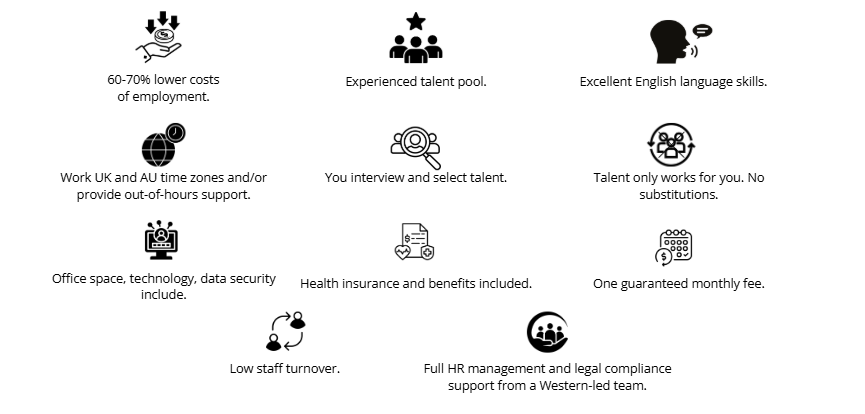
Managing an offshore employee involves much more than paying an invoice. Someone needs to administer payroll, calculate statutory deductions, manage annual and sick leave, maintain employment records, coordinate performance issues, and ensure that any termination complies with local employment law.
What an Employer of Record (EOR) takes care of.
When hiring through an EOR, that breach of compliance law will never happen. The EOR takes care of everything. The EOR provides IT equipment, protects your security and data, and provides HR support should something go wrong. While they are just like your own employees offshore, the EOR acts as your HR department.
Using a reputable Employer of Record substantially reduces these risks because the employment relationship is structured correctly from the outset.

In my experience, businesses rarely get into trouble because they’re trying to avoid their obligations. They get into trouble because they don’t realise those obligations exist. The Philippines has a sophisticated employment framework, just as Australia does.
Understanding both systems is what allows companies to grow confidently.
Another option to engage offshore workers is to set up an overseas entity and hire them directly. We’ve seen clients establish their own Philippine entities, only to later conclude that the cost, administration and difficulty attracting and retaining talent had become major distractions from their core business.
One particular client has been with Yempo for 10 years. Seven of their employees are celebrating 10 years with us in 2026, one has been with us for eight years, and the remaining seven have tenures of between two and seven years.
Setting up an entity requires the following considerations:
A complete HR function covering employee relations, legal compliance, payroll, statutory deductions, employee benefits, leave management, employee engagement and recruitment.
A finance function to ensure the company operates in complete accordance with strict legal and compliance obligations.
The time it takes to establish a reputation sufficient to attract employees.
Establishing an entity is both expensive and time-consuming.
There is also considerable risk for companies setting up their own entities and not investing in the right expertise. It is relatively inexpensive and straightforward for a Filipino worker to bring an employment claim against their employer or former employer. Yempo has been sued several times, and lost only one case, in our first year of operations, before we had properly developed our HR and compliance functions. Even those claims that were dismissed are costly for a company to defend. Mature functions and the right talent minimize this wasted expenditure.
The repercussions of a wrongful dismissal case that takes years to work its way through the system can include backpay covering the entire period since dismissal, separation pay, attorneys’ fees, damages and interest.
Why excellent offshore teams need more than compliant employment.
At Yempo Solutions, our director of People and Culture, Riza, has been with us for 10 years in 2026. She has established a function that covers all the critical elements of a successful HR team, including a Social & Welfare group and an employee benefits package that keep our attrition considerably lower than the industry standard of 60%.
Her expertise has meant that no employee has been successful in a lawsuit since she commenced. This isn’t because we are exploiting loopholes or avoiding responsibility, it’s because we have a smooth-running, compliant HR function, and an excellent employee benefits package.
Yempo’s clients recognize the expertise that a mature Employer of Record provides, allowing them to focus on their core business.
“Yempo manages recruitment, HR, payroll, IT and any ongoing support. We can focus on training and developing our team without having to focus on anything on the administrative side, which is great.” – Victoria, Level Up, UK accountants.
The goal of offshoring shouldn’t simply be to reduce costs. It should be to build a capable, stable team that can grow with your business. Getting the employment structure right from the outset means you can focus on your people and your business, while leaving the complexities of Philippine employment law, HR and compliance to people who deal with them every day.
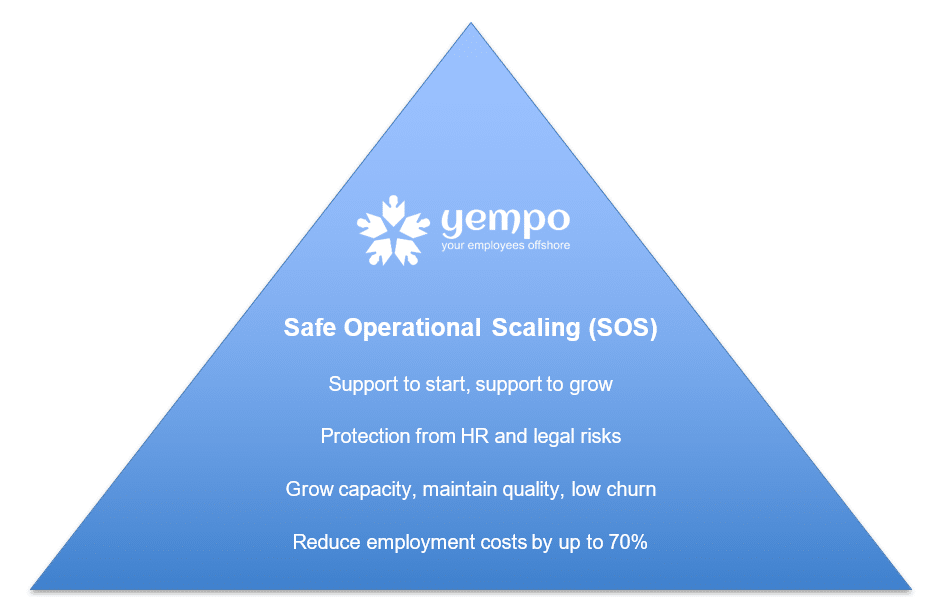
Yempo’s model allows you to manage your people while we take care of everything around them. It’s outsourcing to the Philippines, but in a risk-free manner.
We call it Safe Operational Scaling.
Read More: Fair Pay in Philippine Outsourcing: Quality Beyond Cost Savings
Explore how to make your first offshore hire:
Client Success Stories.
See available talent.
Discuss your goals, get your questions answered, request a quote.