
The UK Accountant’s 2026 Making Tax Digital Survival Guide

What is Making Tax Digital? Who’s impacted and when?
Making Tax Digital (MTD) is the biggest change in UK tax self-assessment for thirty years. Starting April 2026, sole traders and those who receive incomes from property will have to digitally submit quarterly updates to HMRC.
While the annual 31st January self-assessment return remains in place, it’s no longer possible to hand shoeboxes of receipts to accountants just a few weeks before this deadline. Instead, submissions to HMRC of income and expenses from sole trading and property are required every three months; straight from HMRC compatible software.

Quarterly submissions are due by the 7th of the following month…so there’s no time for sole traders and property owners to delay getting aboard with Making Tax Digital…which means they will likely need support from accounting professionals.
Rollout of Making Tax Digital is phased by income band over several years.

Why MTD is an opportunity for UK accountants and bookkeepers.
(S: UK Government)
There will be a huge demand for MTD accounting and software services in 2026 alone.
Overall, 4.5M UK individuals are classed as self-employed. Decreasing MTD income bands 2027-2028 will draw increasing numbers into quarterly digital reporting.
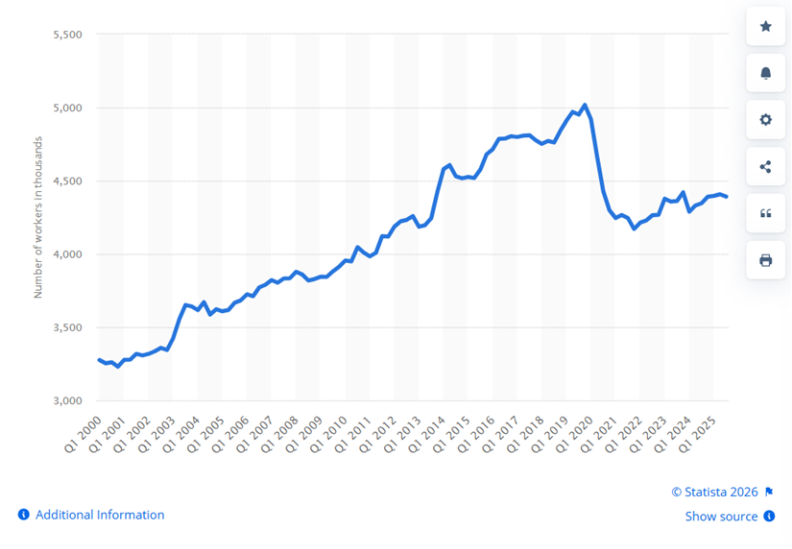
Number of self-employed workers in the United Kingdom from 1st quarter 2000 to 3rd quarter 2025
Accountants and bookkeepers who already have clients who are subject to MTD rules in 2024-2025 will need to use compatible software to:
- Create, store and correct digital records for clients’ self-employment income, property income, expenses.
- Input quarterly updates to HMRC.
- Submit clients’ tax returns by 31st January the following year.
The shift from once-a-year contact with clients to quarterly reporting creates new opportunities to build closer client relationships. It’s also an opportunity to reveal additional accounting needs.
As a minimum, Making Tax Digital opens doors for UK accountants and bookkeepers to:
- Partner with HMRC-compliant software vendors to sell solutions.
- Provide software and MTD training.
- Offer ‘always on’ support when inevitable questions arise.
A typical MTD service offer might look like:

Why profitably servicing MTD will challenge UK accountants and bookkeepers.
A challenge for UK accounting businesses is how to profitably provide MTD services. This problem becomes acute 2027-2028 as lower income bands are drawn into MTD.
This problem is difficult to fix for UK firms that offer MTD services using purely UK based resources.
Why is this? Indeed says (2026):
- The average salary for a UK bookkeeper is £28000/year.
- The average salary for an accountant is £40000/year.
Applying the ‘rule of thirds’ (third salary, third overheads, third profit) used by many UK professional services firms means that these roles must generate:
- UK bookkeeper: £28000 x 3 = £84000/year fee income.
- UK accountant: £40000 x 3 = £120000/year fee income.
Operationally, MTD may present UK accounting firms with service quality challenges generated by:
- The sheer client volumes required to win a profit.
- The demand from the self-employed for out-of-hours support.
How MTD compliant offshore bookkeeping makes MTD profitable for UK accountants.
Yempo Solutions provides dedicated and experienced Philippines-based accounting talent to UK and Australian firms. Our accounting and bookkeeping clients benefit from:
60-70% lower salary costs than equivalent UK employees.
This means:
- Offshore Bookkeeper average salary: £10000/year.
- Offshore Accountant average salary: £14000/year.
Applying the ‘rule of thirds’ (third salary, third overheads, third profit) means that these roles must generate:
- Offshore bookkeeper: £10000 x 3 = £30000/year fee income.
- Offshore accountant: £14000 x 3 = £42000/year fee income.
Profitably servicing MTD clients is made possible without lowering service quality or overpressuring staff. Providing additional services (including out-of-hours support) becomes easy.
Quarterly digital tax reporting in the Philippines is a breeze.
Our model is to provide white label support for UK accounting firms. We engage talent that becomes a dedicated part of your team.
Key benefits of MTD compliant offshore bookkeeping in the Philippines from Yempo Solutions.
- 60-70% lower costs of employment.
- Experienced accounting talent pool.
- Excellent English language skills.
- Work UK time zones and/or provide out-of-hours support.
- You interview and select talent.
- Talent only works for you. No substitutions.
- Familiar with all the major accountancy platforms.
- Office space, technology, data security include.
- Health insurance and benefits included.
- One guaranteed monthly fee.
- Low staff turnover.
- Full HR management and legal compliance support.
‘Communication is excellent, especially when you’re new to outsourcing. Yempo provides the confidence that IT, data protection, and cybersecurity are up to our required standards.’
‘Yempo operates like an ‘e’ supplier. It all just happens.’ – Current Yempo Solutions UK client
How to find the right MTD compliant offshore partner.
Naturally, we’d LOVE you to talk to us about building your offshore MTD compliant team. But we recognise you’ll want to review your options. These blogs will help you to ask the right questions and successfully navigate finding the right offshore accounting partner to make MTD profitable for your firm.
Read more:
Client Success Stories.
See available talent.
Discuss your goals, get your questions answered, request a quote.



Save up to 70% by outsourcing to the Philippines
Accounting & Finance
Find the Finance and Accounting staff that you need through our trusted offshoring solutions.
Learn more
IT & Development
See IT and Development talent you can add to your team by outsourcing to the Philippines.
Learn more
Business Support
Fill your Business Support roles with the highest quality offshore talent from the Philippines.