Skip to content
Logo
  • Solutions
    Dedicated offshore teams

    Build the capacity your business needs.

    Find dedicated Accounting, IT and Business Support professionals who work exclusively for you, while we take care of everything around them.

    • Accounting & Finance
    • IT & Development
    • Business Support
    • Transfer Your Team
  • How It Works
  • Why Us
    Safe Operational Scaling​

    Outsourcing built differently for SMEs.​

    Discover why we provide dedicated, skilled professionals rather than shared resources, put people first, and make offshore growth safer and simpler.​

    • Our Story
    • Our Team
    • Quality and Data Security
    • Corporate Social Responsibility
  • Resources
    OFFSHORE WITH CONFIDENCE

    Make your first or next hire a better one

    Practical advice, guides and client stories to help you understand offshore hiring, avoid the pitfalls and build your team with confidence.

    • Blog
    • Case Studies
    • Guides
    • FAQs
  • Careers
Get a quote
Get a quote

Search Results for: digital+marketing

Why Outsourcing Helps Not-for-Profits Do More With Less

September 8, 2026 by Meg Yarcia

For most not-for-profit organizations, every dollar counts. Leaders are constantly looking for ways to stretch limited budgets while maximizing their impact on the communities they serve. It’s no surprise that cost savings are often the first reason not-for-profits consider outsourcing, particularly offshore outsourcing. By leveraging highly skilled talent in countries like the Philippines, organizations can access significant financial efficiencies compared to hiring locally. 
 
At Yempo, we have clients that are professional services firms such as accounting practices, audit firms, and consultancies. Many of these businesses serve the not-for-profit sector, helping with governance, financial reporting, compliance, and advisory services. When these firms outsource to Yempo, they lower their own cost base –  savings that can ultimately be passed on to the not-for-profits they support. In this way, outsourcing indirectly delivers cost efficiencies to charities and NGOs, allowing more funding to be directed toward their missions. 

But while cost is a powerful driver, it’s not the only reason outsourcing makes sense for not-for-profits and the ecosystem of businesses that support them. The benefits extend far beyond saving money, and when executed well, outsourcing can actually help charities achieve greater impact, deliver services more effectively, and demonstrate accountability to their donors.  

Access to Specialist Skills Without Full-Time Costs 

Many not-for-profits struggle with the need for professional expertise in areas like finance, IT, digital marketing, or donor management. Hiring full-time specialists in these fields can be prohibitively expensive, and often the workload doesn’t justify a permanent hire. By outsourcing to partners like Yempo, service providers such as accounting and audit firms can expand their capabilities and provide not-for-profits with access to this expertise at a fraction of the usual cost. 
 
For example, an NGO that relies on an accounting firm for year-end reporting benefits indirectly when that firm augments its team offshore. The not-for-profit gets professional service and compliance delivered efficiently, without bearing the high cost of local resourcing. 

Scalability and Flexibility in Changing Times 

Not-for-profits rarely operate with consistent, predictable workloads. Campaigns, donor drives, and grant reporting deadlines create peaks and troughs in demand. Outsourcing gives the firms that service these organizations the ability to scale resources up or down depending on the season, ensuring not-for-profits receive timely, high-quality support. 

Freeing Up Focus for the Mission 

By working with outsourcing providers, professional service firms can streamline back-office functions and repetitive tasks. This frees them to focus on higher-value activities –  like strategic advisory, governance, and financial stewardship –  that help not-for-profits stay mission-driven rather than bogged down in administration. 

Improved Efficiency and Professional Standards 

One of the hidden strengths of outsourcing is the ability to tap into tried-and-tested processes. Yempo, for example, brings professional-grade systems, tools, and best practices to our client engagements. When applied through accounting or auditing firms, these efficiencies flow down to the not-for-profits they support, enabling charities to benefit from corporate-level professionalism without carrying the cost. 

Global Perspective and Diversity of Thought 

The diversity of offshore teams enriches the service that firms can provide to not-for-profits. A broader global perspective often translates into new ideas and approaches that benefit the sector, especially organizations working across borders or in culturally diverse communities. 

Reducing Risk in Complex Areas 

Compliance, data security, and business continuity are areas where not-for-profits can feel overwhelmed. By outsourcing through their trusted accounting or auditing partner, they indirectly gain access to secure systems and compliance expertise –  reducing risk without having to manage it themselves. 

Donor Appeal Through Transparency and Efficiency

Finally, outsourcing strengthens the value proposition of service providers who work with not-for-profits. When accounting and auditing firms can deliver high-quality work at a lower cost, charities can demonstrate to donors that funds are being used wisely and efficiently. This transparency and efficiency build confidence and trust, ultimately supporting fundraising success. 

Doing More With Less 

Outsourcing isn’t just a cost-cutting tool; it’s a way of creating efficiencies across the entire ecosystem that serves not-for-profits. By partnering with providers like Yempo, accounting and auditing firms can reduce costs, enhance service delivery, and pass those benefits on to their clients. 
 
The outcome? Not-for-profits gain access to the skills, efficiency, and professionalism they need to thrive –  while ensuring every donated dollar goes further toward creating positive change.

Yempo: Your Partner for Peace of Mind in Outsourcing   

Yempo can walk you through the process of adding offshore accounting and remote IT talent to your team, drawing from decades of combined experience in outsourcing.  

Get in touch today to save money and find the quality talent your business needs! 

Book a quick chat with Michelle today, to know more about our best practices in providing offshore accounting and IT staff from the Philippines – or shoot us an email at [email protected]. We are happy to answer your questions! 

Learn more: 

  • The definitive guide to outsourcing in the Philippines 
  • Working with Yempo 

Filed Under: Your First Offshore Hire

Victoria’s Proposed Work From Home Laws Could Change More Than Where People Work (and How Outsourcing Can Help)

July 28, 2026 by Ian Parkin

The Victorian Government’s proposed Work From Home laws have generated considerable debate across Australia’s business community. As a committed offshore IT, business support, and accounting outsourcing partner to many Aussie SMEs, we have looked into this subject closely.

If passed in their current form, eligible employees whose roles can reasonably be performed remotely would gain a legal entitlement to work from home for up to two days each week. Employers wishing to refuse a request would need to demonstrate that doing so is not reasonable under the criteria set out in the legislation.

Whether you support or oppose the proposal, one thing is certain: many businesses will soon be asking an important question.

Can this role be performed remotely?

It’s an operational question that every employer should be considering. But there is another question that naturally follows.

If a role can be performed remotely, does it also need to be performed in Australia?

The Workplace Has Already Changed

The pandemic fundamentally changed the way businesses think about work.

Many organisations discovered that productivity could be maintained, or even improved, when employees worked from home. Others concluded that collaboration, mentoring, and company culture suffered without regular face-to-face interaction.

The reality is that there is no universal answer. Every business is different, and every role is different.

The proposed Victorian legislation doesn’t create remote work. It simply recognises that many jobs can already be performed from almost anywhere.

For businesses, that may become the catalyst for a broader strategic review.

Not Every Role Needs To Be Local

Some positions will always require a physical presence.

Reception staff, warehouse employees, laboratory technicians, retail workers and many healthcare professionals need to be where the work is performed.

However, many knowledge-based roles are different.

  • Accounting.
  • Customer service.
  • Digital marketing.
  • Graphic design.
  • Software development.
  • Bookkeeping.
  • Administration.
  • Recruitment.
  • Engineering support.
  • Estimating.

For many businesses, these roles have already proven they can be performed successfully outside the traditional office.

If location is no longer the deciding factor, employers should also ask whether geography still matters.

Looking Beyond The Office

For years, businesses have compared office-based work with working from home.

Increasingly, the more relevant comparison may be between local employees working remotely and offshore employees working remotely.

Both require strong management.

Both rely on technology.

Both depend on effective communication and clearly defined processes.

The difference is that an offshore strategy also provides access to significantly larger talent pools and can substantially reduce employment costs.

That doesn’t mean every role should be offshored. But it does mean businesses should evaluate all available options rather than limiting the conversation to where an Australian employee performs their work.

Workforce Strategy Is About More Than Cost

When people think about building offshore capability, they often think only about salary savings.

Cost is certainly one factor, but it is rarely the only reason businesses build offshore capability.

Many employers are struggling to recruit experienced professionals in highly competitive labour markets.

Others want to scale more quickly than local hiring allows.

Some are seeking extended operating hours, improved business continuity or access to specialist skills that are difficult to source locally.

In many cases, offshore teams become an extension of the existing workforce rather than a replacement for it.

Australian managers remain responsible for leadership, quality and client relationships, while offshore professionals perform work that can be delivered just as effectively from another location.

The Best Time To Review Your Workforce Isn’t During A Crisis

Too often, businesses only rethink their workforce after costs have increased or recruitment has become difficult.

The proposed Victorian legislation is another reminder that workforce planning should be proactive rather than reactive.

Whether the Bill ultimately passes in its current form or is amended during the parliamentary process, it has already prompted many business leaders to examine how work is performed within their organisations.

That exercise has value regardless of the legislation’s final outcome.

Questions worth asking include:

  • Which roles genuinely require an office presence?
  • Which roles can be performed remotely without affecting quality or customer service?
  • Which functions are becoming increasingly difficult or expensive to recruit locally?
  • Could an offshore team strengthen the business while allowing local employees to focus on higher-value work?

These are strategic questions, not simply HR questions.

Looking Ahead

The proposed Victorian Work From Home laws are still making their way through Parliament, and aspects of the legislation may change before becoming law.

However, they reflect a broader trend that has been developing for several years.

Work is becoming less tied to a physical location.

Businesses that embrace this shift thoughtfully will often find opportunities that extend well beyond working from home.

For some organisations, that may mean introducing more flexible workplace policies.

For others, it may mean building a high-performing offshore team that complements their Australian workforce.

Either way, the most successful businesses will be those that look beyond today’s headlines and use this moment to ask a much bigger question.

Not just “Where should our people work?” but “What is the best workforce strategy for the future of our business?

Get Started

To know more about responding to business challenges through accounting, business support, and IT outsourcing to the Philippines, get in touch with Yempo Solutions here.

Filed Under: Compliance Tagged With: featured

How to build a GDPR-compliant team in the Philippines.

May 19, 2026 by Michelle Fiegehen

Why compliance with privacy legislation is outsourcing 101

Most businesses rely on earned trust to earn their crusts. Which makes respecting customers’ privacy central to business success.

Recommendations and referrals drive over 80% of B2B sales. Customer reviews fuel online B2B and B2C sales. And good favour doesn’t come any business’s way if there’s any hint that it might misuse customers’ data and / or fail to keep it safe.

Yes, brand building marketing is critical to grow wider appeal. And email, PPC, SEO, AI search all support demand generation. But decisions in your favour happen far more often when leads read favourable testimonials…or have their view confirmed by a recommendation from someone whose opinion they trust.

Yempo Solutions is no different. Recommendations and referrals drive much of our business. Testimonials turn interest into intent. Which makes helping our clients to comply with privacy legislation a key pillar of our business model.

What is GDPR?

The General Data Protection Act is, post Brexit, two acts.

  • UK GDPR: introduced Jan 1, 2021, is a retained version of the EU Data Protection Act 2018, with small amendments for the UK.
  • EU GDPR: Applies to all EU member states and EEA countries.

Both versions of GDPR apply to organisations outside of UK and EU jurisdictions where these organisations handle UK and EU individuals’ data outside of the EU. Which is why GDPR compliance and outsourcing to the Philippines are intrinsically linked.

Read More: A comprehensive guild to UK vs EU GDPR legislation

EU GDPR vs UK GDPR

The 7 GDPR principles that impact offshore IT, offshore accounting, and offshore business support teams

GDPR contains seven key principles that firms handing personal data must comply with. Personal data must be:

  1. Processed lawfully, fairly and in a transparent manner in relation to individuals.
  2. Collected for specified, explicit and legitimate purposes and not further processed in a manner that is incompatible with those purposes; further processing for archiving purposes in the public interest, scientific or historical research purposes or statistical purposes shall not be considered to be incompatible with the initial purposes.
  3. Adequate, relevant and limited to what is necessary in relation to the purposes for which they are processed.
  4. Accurate and, where necessary, kept up to date; every reasonable step must be taken to ensure that personal data that are inaccurate, having regard to the purposes for which they are processed, are erased or rectified without delay.
  5. Kept in a form which permits identification of data subjects for no longer than is necessary for the purposes for which the personal data are processed; personal data may be stored for longer periods insofar as the personal data will be processed solely for archiving purposes in the public interest, scientific or historical research purposes or statistical purposes subject to implementation of the appropriate technical and organisational measures required by the GDPR in order to safeguard the rights and freedoms of individuals.
  6. Processed in a manner that ensures appropriate security of the personal data, including protection against unauthorised or unlawful processing and against accidental loss, destruction or damage, using appropriate technical or organisational measures.
    In addition, article 5(2) adds that:
  7. The controller shall be responsible for, and be able to demonstrate compliance with, paragraph 1.

Learn more about UK GDPR: UK Information Commissioners Office GDPR Guides.

We’ve highlighted principle 6, data processing, as ‘ensuring appropriate security of personal data’ impacts outsourcing. But it depends on what we mean by outsourcing.

How GDPR impacts different outsourcing models.

Scenario A – a business hands over complete responsibility for a task to a third party.

This is true outsourcing. The outsourcer can decide how to manage and complete the task – including personal data handling and compliance. And here comes the BIG BUT. The client business cannot also hand over responsibility for GDPR compliance, even if the outsourcing happens outside the EU or UK.

In this scenario, contracts must cover how GPPR compliance is maintained. Auditing needs to be in place to ensure that GDPR compliance commitments are met.

The consequences if this goes wrong are considerable. In the UK, these can amount to £17.5 million or 4% of the total annual worldwide turnover in the preceding financial year, whichever is higher.

Scenario B – Yempo Solutions provides dedicated to you talent.

In this scenario, offshore talent is technically employed by Yempo Solutions (as a registered Employer of Record in the Philippines). Practically, talent only works for your business as pseudo ‘remote employees’.

They:

  • Use your business processes;
  • Use your systems;
  • No data transfer takes place;
  • Responsibility for GDPR training and compliance remains with you.

The only client-side personal data Yempo Solutions holds is your company phone number, company address, and email addresses, and our contract with you. This makes is possible to build (for example) a GDPR-compliant IT helpdesk in the Philippines, or an offshore accounting pool that answers your clients’ Making Tax Digital queries.

An easy way to think of it is to operate the same processes you use when engaging a UK-based remote employee in Birmingham when your office is in Brighton.

Scenario C – You build a directly employed team in the Philippines.

In this scenario, you GDPR train your offshore team in the Philippines as you would your UK-based team.

This scenario can work well for large employers that can afford the necessary internal legal and HR expertise. But direct employment adds significant legal risk for UK SMEs.

Unlike some countries, the Philippines has comprehensive employment legislation. Compliance with this legislation requires expertise that most SMEs lack.

Yempo Solutions is a registered Employer of Record in the Philippines and so ensures compliance with employment regulations, protecting SMEs from risk.

Learn more:

Complying with Common Philippines Labour Laws: A Guide for Outsourcing

Outsourcing to the Philippines without the legal risks.

‘Peace of mind. An employer who fully understands local labour laws.’ – David D., Yempo Solutions client

GDPR training for offshore teams

Compliance is integral to Yempo Solutions’ operating model, just as it is for yours. As a company, we comply with the requirements of the Australian Privacy Act. Many requirements follow GDPR rules. But there are important differences.

Read: GDPR vs Australian Privacy Act

GDPR training for offshore teams remains your responsibility. In our experience, clients prefer this model as there’s no ambiguity. They know exactly what training has, and has not, been received. They complete GDPR compliance audits on their offshore talent in the Philippines as they would local teams.

How UK SMEs can build a GDPR compliant team in the Philippines.

With over a decade’s experience enabling small and medium-sized enterprises to build offshore teams in the Philippines, our team of experts will provide end to end support for you (particularly valuable if you’re new to outsourcing).

We will lead you through our proven three-step process:

1. Identify the skills you need that will free up your higher cost staff.

Let us know your requirements, be they IT Technical Analysts, Developers, or Testers. Maybe you need a bookkeeper or accountant? We source the best staff to meet your needs, personally screen them and submit a shortlist for your review.

You interview a shortlist via a video call to determine their suitability for your needs. Give us the go-ahead and we make an offer to the individual(s) you select, and complete police and other security checks.

2. Allocate a staff member in your home team to train the new hire.

Just as you would in your own office, you onboard your new hire via video conference, using our robust infrastructure.

3. We do the rest! We take care of your staff, payroll, and employee compliance.

We ensure your staff members feel a part of the Yempo Solutions team in an excellent working environment while being dedicated and fully committed to only your business.

We also provide you with cultural primers that will help you get the best out of your new employees. Building a whole team? We step back a little and support you in promoting your own culture into your offshore team.

You only need to ensure that your new IT, Accountancy and / or Business Support staff are kept busy.

Any performance concerns or issues, just contact us and we will take care of the rest.

Get started – build your GDPR compliant team in the Philippines.

Why companies prefer outsourcing to the Philippines with Yempo Solutions:

  • Specialist provider of quality, lower cost, IT, Accounting and Business Support resources.
  • Access to high quality, well educated, accountancy & IT staff.
  • Cost effective versus local hires (save 70%.)
  • End to end support, from IT, legal, and HR compliance.
  • High quality technology.
  • Happy staff that are treated as you would your in-country teams.
  • Ability to rapidly flex teams and facilitate growth.
  • Ready access to happy clients for reference-checking the entire experience.

Get started – build your GDPR compliant team in the Philippines: https://www.yempo-solutions.com/outsourcing-solutions-philippines/

Filed Under: Compliance

Five ways that SMEs can thrive in a low growth Australian economy by outsourcing to the Philippines through Yempo Solutions.

November 15, 2025 by Michelle Fiegehen

SMEs in Australia: How to thrive during a period of weak economic growth.

As we look ahead to 2026, many Australian small and medium enterprises (SMEs) are facing markets with continuing slow growth. Data from the Australian Bureau of Statistics (ABS) shows that the Australian economy grew only 1.8 percent year on year: not bad compared with many advanced nations but still the weakest annual growth, excluding the COVID period, since the early 1990s.

Gdp

S: https://www.abs.gov.au/statistics/economy/national-accounts/australian-national-accounts-national-income-expenditure-and-product/jun-2025

With domestic growth sluggish, many SMEs face tighter margins, subdued demand, and rising pressure to manage costs. Remaining profitable requires a rethink of teams are structured. For many SMEs, engaging quality talent overseas is increasingly a margin preserving necessity.

We’ve listed five proven ways that our remote talent can help your business remain competitive without compromising capability or reputation.

1. Reduced costs, broader services.

Many Australian SMEs operating in IT, accounting, and professional services rely heavily on consumers’ demand for their clients’ services. When consumer demand is weak, their clients pass on pressures they face in the form of contract renegotiations. A ‘local employees only’ model makes it hard for suppliers to respond. Where headcount cuts are necessary, then problems can get worse as they can impact service quality.

Outsourcing provides a stronger and longer-term solution. By engaging skilled remote professionals from the Philippines, SMEs significantly reduce employment costs without reducing operational output. In fact, it becomes possible to offer a broader range of services because lower employment costs make otherwise unprofitable activities worthwhile. Deepening client relationships in this way helps to shutout competitors.

For IT service providers, managed service providers and accounting firms, staff location typically has negligible effect on work quality. What matters is expertise, communication, reliability and support: all of which are well provided for by Yempo Solutions model.

For SMEs with back-office functions such as executive assistants, schedulers, customer support, and document controllers, staff can all be handled remotely with no loss of performance.

SMEs that structure their teams in this way keep service levels high, maintain capacity, and remain cost competitive at the same time.

2. Free up budget to fund your key local roles that make the biggest differences.

In slow growth conditions, the most resilient businesses act to protect their front-line sales teams, account managers, and customer experience roles. All are essential to winning and retaining business.

Back-office roles, although important, are not client facing and do not need to be performed locally.

By outsourcing admin, bookkeeping, IT support, digital tasks, finance processing, and data handling Australian SMEs can:

  • Protect revenue generating roles.
  • Maintain strong customer service during tight economic conditions.
  • Reinvest savings into marketing, sales, and business development.
  • Preserve service quality and brand reputation.

3. Stop larger companies that already engage overseas talent from eating your lunch.

Most large companies built overseas teams years ago. They already benefit from:

  • Lower labour costs.
  • Greater staffing flexibility.
  • Increased capacity.
  • Faster scaling options.
  • Access to larger talent pools.
  • The ability to provide extended or round-the-clock support.

If smaller businesses engage just local talent then as they scale, they risk being uncompetitive on both price and service capability vs larger alternatives. Outsourcing to the Philippines removes a growth blocker. It becomes about far more than cheaper labour.

Working with Yempo Solutions gives SMEs access to the same global team strategies used by major corporates, without the complexity or risk of setting up offshore operations themselves.

See client success stories.

4. Add flexibility and up/down scalability that simplifies responses to economic shifts.

Economic sluggishness creates hesitation around local hiring. Permanent salaries, recruitment costs, compliance obligations, and training requirements all add friction for SMEs that need to remain agile.

Yempo Solutions offers flexibility that traditional hiring cannot match:

  • Start with one remote employee to trial the model.
  • No recruitment or setup fees.
  • Remote employees work Australian hours (unless extended hours are preferred).
  • Cancel or scale with only one week’s notice.
  • If you do not love the candidate, you pay nothing.

This flexibility is ideal for businesses that work on a contract basis and so may need to adjust capacity at short notice. It’s a way to add operational resilience without long term commitments.

5. Test low cost overseas talent with zero risk and full support.

There is a misconception that outsourcing requires complex systems or major operational changes. With Yempo Solutions, the process is simple, structured, and completely supported by a partner with a decade of proven success supporting Australian SMEs.

  • Australian CEO leading operational support.
  • Transparent and predictable pricing.
  • You provide computer specifications and Yempo Solutions handles everything else.

This makes it easy to prove remote hiring works for your business before scaling. You can experience the benefits of outsourcing the Philippines with minimal risk.

Try us.

Book a quick chat with Michelle today, to know more about our best practices in providing offshore accounting and IT staff from the Philippines – or shoot us an email at [email protected]. We are happy to answer your questions!

Learn more:

  • The definitive guide to outsourcing in the Philippines
  • Working with Yempo

Read more helpful information about outsourcing from Australia or the UK to the Philippines:

  • 5 Huge Financial Advantages of Outsourcing Australian Accountancy Functions
  • 5 Huge Financial Advantages of Outsourcing Australian IT Development Functions
  • Top 8 industry sectors that most frequently outsource to the Philippines
  • Outsourcing to the Philippines: Ensuring Fair Pay, Benefits, and Conditions
  • Fair Work and Offshore Hiring: Philippines Compliance

Filed Under: Your First Offshore Hire

Global SMEs and Uncertainty: Outsource to the Philippines

June 15, 2025 by Michelle Fiegehen

Navigating Global Economic Uncertainty: A Strategic Shield for SMEs

Much attention has been paid to large-scale macroeconomic shifts instigated by President Trump, yet the most pronounced and enduring impacts have been felt at the SME level. Small and medium-sized businesses in the UK, Australia, and beyond now face rising costs, trade uncertainty, and a changing competitive landscape. Fortunately, smart strategies like outsourcing to the Philippines offer viable pathways to survive and thrive.

Global Trade Shifts: The Impact on SMEs

Trump’s tariffs, especially those targeting China, have disrupted global trade and pushed up costs. SMEs relying on Chinese imports for raw materials or finished goods are experiencing financial strain. This includes not just US businesses, but trading partners like the UK and Australia, whose economies are deeply integrated with global supply chains.

UK SMEs importing components from China have been caught in the crossfire, as rising US-China trade tensions force up global prices.

Australian SMEs, especially in manufacturing and technology sectors, face longer lead times and higher procurement costs due to diverted supply chains and higher freight charges.

Cost Pressures: Why Traditional SME Solutions Fall Short

If an SME wishes to continue with a full ‘in-country’ employee business model, then there are really only three options open for business leaders to mitigate cost pressures. And they are not super attractive. The options:

1. Absorb costs

Pros:

  • Maintains customer trust and market competitiveness.
  • Avoids shock to demand from sudden price hikes.

Cons:

  • Cuts into (possibly already narrow) profit margins.
  • Unsustainable long-term costs continue to rise.

2. Passing costs on to customers

Pros:

  • Preserves profit margins.
  • Helps to maintain business operations and staffing levels.

Cons:

  • Risks losing customers, especially in price-sensitive markets.
  • May open opportunities for cheaper competitors to undercut.

3. Negotiating with suppliers

Pros:

  • Can reduce unit costs, especially with long-term contracts.

Cons:

  • Small businesses may lack leverage.
  • Supplier quality or reliability may be compromised due to reduced prices.

Outsourcing to the Philippines: Your Strategic Advantage

One of the most powerful tools SMEs can use to counter these economic pressures is outsourcing—especially to a high-skill, low-cost destination like the Philippines. Here’s how:

1. Outsourcing accounting services

SMEs in the UK and Australia are increasingly turning to outsourcing accounting services to manage rising domestic labor costs. The Philippines offers:

  • Chartered accountants trained in IFRS and fluent in English.
  • Cost savings of up to 70% over hiring locally.
  • Scalability—it’s relatively fast (vs. UK and AU) to scale teams up or down.

Whether it’s bookkeeping, payroll, or compliance, offshore accounting provides UK and Australian firms with better margins and reduced administrative burdens.

2. Offshore accounting for regulatory efficiency

Both UK and Australian SMEs face strict financial reporting standards (e.g., Making Tax Digital in the UK, or STP reporting in Australia). Offshore accounting teams in the Philippines can seamlessly support these regulations using cloud-based tools like Xero, MYOB, and QuickBooks.

3. Hiring remote employees to reduce overheads associated with internal functions.

Hiring a remote employee in the Philippines—whether in accounting, customer service, digital marketing, or operations—helps SMEs:

  • Save on office space, insurance, and utilities.
  • Fill skill gaps in areas like data analytics or IT support.
  • Operate extended hours with time zone advantages.

This has been particularly attractive to Australian SMEs, where similar time zones enable smooth collaboration and communication.

4. Outsource IT functions

IT departments are costly to staff locally, especially for SMEs. With outsourced IT solutions based in the Philippines, businesses can:

  • Access 24/7 tech support.
  • Enhance cybersecurity with skilled, certified engineers.
  • Build custom software or maintain infrastructure for less than half the domestic cost.

Yempo enables UK and Australian businesses from a broad range of sectors to outsource their IT (by adding dedicated, lower cost, remote employees to their teams). Our clients can accelerate innovation and keep their operational costs low.

Beyond Cost Savings: Outsourcing as a Survival Strategy

Donald Trump’s reshaping of the global economy has imposed lasting costs on SMEs far beyond US borders. Supply chain instability, currency swings, and tariff-driven inflation have put pressure on businesses to adapt or risk decline.

Outsourcing to the Philippines presents a strategic opportunity. Whether through offshore accounting, hiring remote employees, or choosing to outsource IT, SMEs can counteract rising costs, increase efficiency, and remain competitive on a global scale.

In times of uncertainty, smart use of remote employees isn’t just a cost-saving tactic – it’s a survival strategy.

Partner with Yempo for Success

If your current outsourcing provider struggles to deliver loyal, qualified talent, it’s time to switch to Yempo. Our proven track record, client testimonials, and employee-focused approach make us the ideal partner for outsourcing to the Philippines.

Book a quick chat with us today, to know more about our best practices in providing offshore accounting and IT staff from the Philippines – or shoot us an email at [email protected]. We are happy to answer your questions!

Read more:

  • The definite guide to outsourcing in the Philippines
  • Explore our case studies, inventive strategies, and transparent pricing models

Filed Under: Your First Offshore Hire

Five ways UK SMEs can thrive in 2026’s low growth economy by leveraging overseas talent through Yempo Solutions.

January 20, 2025 by Meg Yarcia

How UK SMEs can maintain margin, keep clients, and grow sales during dismal economic growth.

As we approach 2026, UK small and medium enterprises (SMEs) face an economic reality that is difficult to ignore. Consumer spending, the engine that drives the UK economy both directly (B2C) and indirectly (B2B), is set for only the smallest of uplifts. The UK government’s own forecaster, the IFS, believes disposable income will rise by just 0.5% per year for the period 2026-2030. That’s a measly £104 per person per year (S: https://www.bbc.co.uk/news/articles/c75vwevr652o)

Growth in living strands is set slow

With spending power barely improving, many SMEs will face pricing and cost pressures. Remaining competitive, profitable, and resilient requires businesses to rethink how they structure their operations, particularly what they pay for team members.

Historically, engaging high quality overseas talent through an experienced outsourcing partner like Yempo Solutions might have been as an operational efficiency. But in 2026, it’s increasingly a margin preserving necessity.

Here are five ways that outsourcing the right roles with us can enable UK SMEs to navigate this low growth environment and build in necessary flexibility.

1. Respond to weak consumer demand by reducing costs without reducing capability.

Many of our clients in IT and accounting support businesses that rely on consumer spending. Persistent low spending growth means they need a mechanism to manage overheads that doesn’t impact performance.

Traditionally, cost-cutting means reducing headcount. But this doesn’t work for businesses that wish to win and keep clients. Cuts can’t mean reduced output, slower delivery, poorer service. Adverse outcomes (like these) represent too high a risk approach in an ever more competitive market.

This is where quality, yet lower cost remote employees become a meaningful game-changer.

Overseas professionals enable SMEs to drastically reduce their employment costs without impacting capacity or service quality. This is particularly true for IT Managed Service Providers (MSPs) and Accounting firms where staff’s location makes little difference. Our clients consistently feedback how positively this works for them. Why? Qualified talent with great English skills and flexibility.

Of course, if a business has a back-office team, the case for moving these roles offshore is even more compelling. Business Support roles such as Exec Assistants, Sales Agents and Document Controllers can operate from any location.

SMEs can drastically reduce employment costs without sacrificing operational capability. Tasks continue to be completed, customers remain supported and business processes stay consistent.

2. Free up budget for the roles that make the biggest difference.

In slow growth times, the strongest SMEs protect front line staff. Sales roles, delivery roles, and customer experience roles remain fundamental to winning and keeping business. Cutting talent from these areas undermines competitiveness and revenue generation.

What can be reduced instead are the roles that do not require local presence.

By outsourcing administrative tasks, finance processing, data handling, IT development and support, scheduling and digital functions, companies can:

  • Protect front office, revenue-generating roles.
  • Maintain strong customer-facing service even when budgets are tight.
  • Re-invest savings into marketing, sales activities, and business development.
  • Preserve brand reputation and service quality.

Many of our UK clients engage offshore teams specifically to fund and free up the time of critical front office teams. Yempo Solutions enables SMEs to protect customer facing capabilities by shifting back-office roles to lower-cost, high-quality overseas professionals.

3. Stay competitive with larger companies that already engage overseas talent.

Another challenge for UK SMEs is that larger competitors have been outsourcing overseas for many years. Their bids already benefit from:

  • Lower labour costs.
  • Higher staffing flexibility.
  • Greater operational capacity.
  • Faster scaling options.
  • Access to global talent.
  • Round-the-clock support potential.

If small businesses continue relying on UK only hires while large competitors have lower cost offshore teams, then they risk playing uncompetitive hands. Outsourcing to the Philippines is about far more than just cost savings. For the period 2026-30, it’s become a new business essential.

Working with Yempo Solutions helps level your playing field. SMEs gain access to the same international talent strategies used by major corporates, but without the complications, commitments, or risks that come with building an offshore function independently.

4. Add flexibility and resilience in an uncertain economy.

Economic uncertainty makes employers hesitant to hire. Fixed salaries, NI contributions, recruitment fees, training, and legal obligations create friction for SMEs that need the protection agility delivers. Yempo Solutions provides this agility and flexibility:

  • Start with just one person to trial the model.
  • No recruitment or setup fees.
  • Your remote employees work UK hours (unless you prefer extended hours).
  • Cancel with only one week’s notice.
  • If Yempo does not find candidates you love, you pay nothing.

This flexibility is ideal for companies with unpredictable demand, or that want to offer their own clients flexible arrangements as a means to win more bids.

Many UK SMEs already use Yempo Solutions to:

  • Reduce employment costs by up to 70%.
  • Fill roles that are hard to recruit locally.
  • Add this essential operational flexibility.

If these needs resonate with you, then talk to us.

5. Test low cost overseas talent with zero risk and full support.

A common misconception about outsourcing is that it requires complex systems or large-scale team migrations. Yempo Solutions makes the experience simple and accessible for SMEs of any size.

Our model is uniquely SME friendly:

  • Start small with a single hire.
  • Full Western-led HR, legal and operational support.
  • Transparent, predictable pricing.
  • You provide the PC specifications, Yempo Solutions provides everything else.
  • No long commitments.
  • Talent that’s aligned with the UK time zone.

This makes it easy to test adding remote team members to your business before scaling operations abroad.

What are you waiting for?

With households gaining only around £104 per year in real spending power, the UK consumer economy will remain under pressure for several years. SMEs that continue relying on high-cost, fully domestic staff solutions risk being squeezed by competitors who can already price in lower-cost global teams. SMEs that embrace outsourcing via us can:

  • Reduce their cost base significantly.
  • Maintain and enhance front office strength.
  • Stay competitive with larger providers.
  • Add essential agility.
  • Improve service levels.
  • Test the model safely, without risk.

Book a quick chat with Michelle today, to know more about our best practices in providing offshore accounting and IT staff from the Philippines – or shoot us an email at [email protected]. We are happy to answer your questions!

Learn more:

  • The definitive guide to outsourcing in the Philippines
  • Working with Yempo

Read more helpful information about outsourcing from Australia or the UK to the Philippines:

  • 5 Huge Financial Advantages of Outsourcing Australian Accountancy Functions
  • 5 Huge Financial Advantages of Outsourcing Australian IT Development Functions
  • Top 8 industry sectors that most frequently outsource to the Philippines
  • Outsourcing to the Philippines: Ensuring Fair Pay, Benefits, and Conditions
  • Fair Work and Offshore Hiring: Philippines Compliance

Filed Under: Your First Offshore Hire

Outsourcing IT and Development to the Philippines: A Step-by-Step Outsourcing Guide for Business & HR leaders

February 2, 2024 by Michelle Fiegehen

You’d like to grow your IT business? Or perhaps you’re running another kind of business, but resourcing IT and development skills takes up too much of your time and budget?

Our definitive guide explains how outsourcing your IT and Development staffing requirements to the Philippines can boost growth, streamline processes, and save costs. You’ll know how to evaluate potential outsourcing partners and select the best staff for your organisation.

Why outsource IT and Development staff?

You’d like to take advantage of demand in your
local market? But finding the right talent is an
issue? Australia’s tech talent shortage is
particularly acute because its tech sector is
growing twice as fast as the overall Australian
economy (source: Tech Council of Australia
2023).

‘’We wanted to find local staff but couldn’t.
Yempo gives us the senior IT expertise that other
outsourcers cannot provide” explains Ron
Rosenbaum, Director of Yempo client ‘The IT
Agency’

The Tech Council of Australia predicts a shortfall of around 260,000 skilled tech workers by
2025.

The talent shortage will prevent Australia from becoming a top 10 digital economy by 2030.

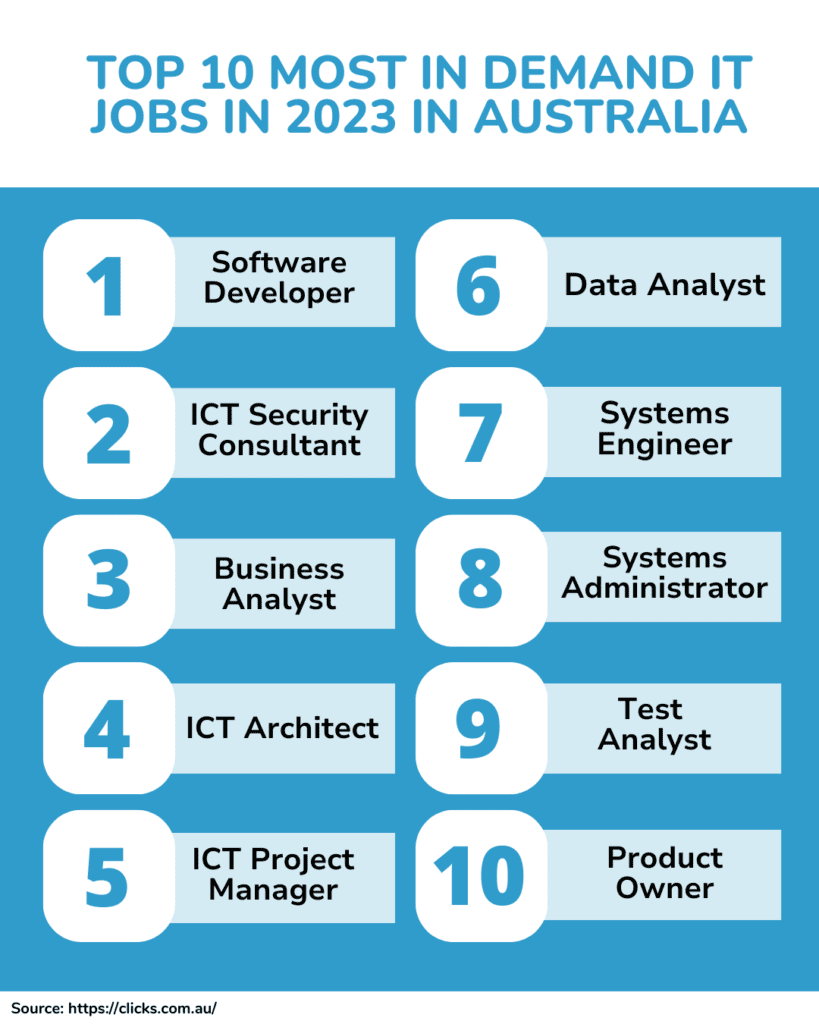
No logo top 10 most in demand it jobs in 2023 in australia 819x1024

By analyzing Clicks’ market research, recruitment data, and the Australian Government’s jobs and skills data, we have compiled a list of the top ten IT jobs that are in high demand in 2023. Result? Many of our clients report that they are suffering high turnover rates and rising salary costs within their locally based IT teams.

We commissioned an independent research partner to interview our IT clients to understand how their businesses are addressing these challenges by building offshore teams in the Philippines.

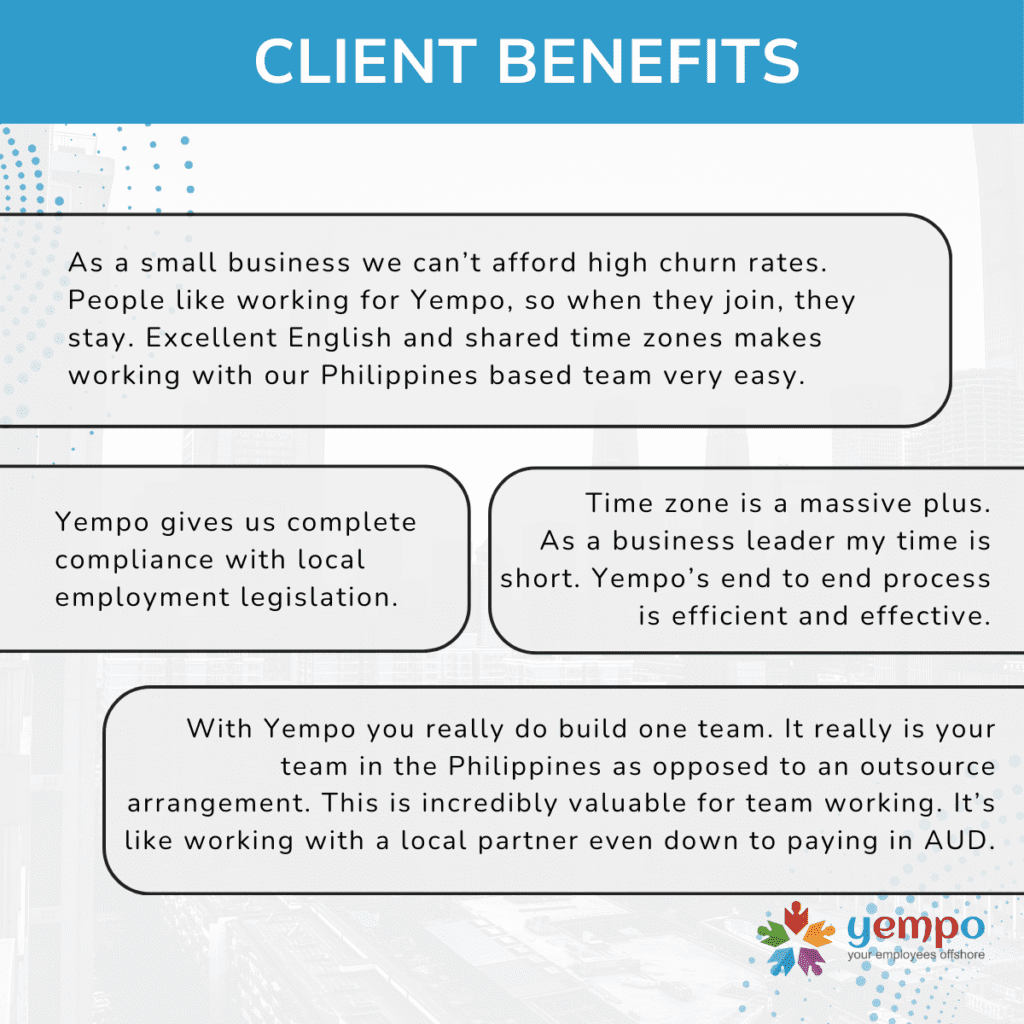
Client benefits 1024x1024

In addition, they reported that they can:

  • Overcome local labor shortages and continue to grow their businesses.
  • Reduce employee turnover; less management time training new employees.
  • Free up leadership time for higher value tasks, focus on growth, not processes.Reduce costs by up to 70% (vs. local hires); improved margin and profit.
  • Build one global team; English skills, culture and time zones play well for them.

Why doesn’t everyone outsource IT & Development staff?

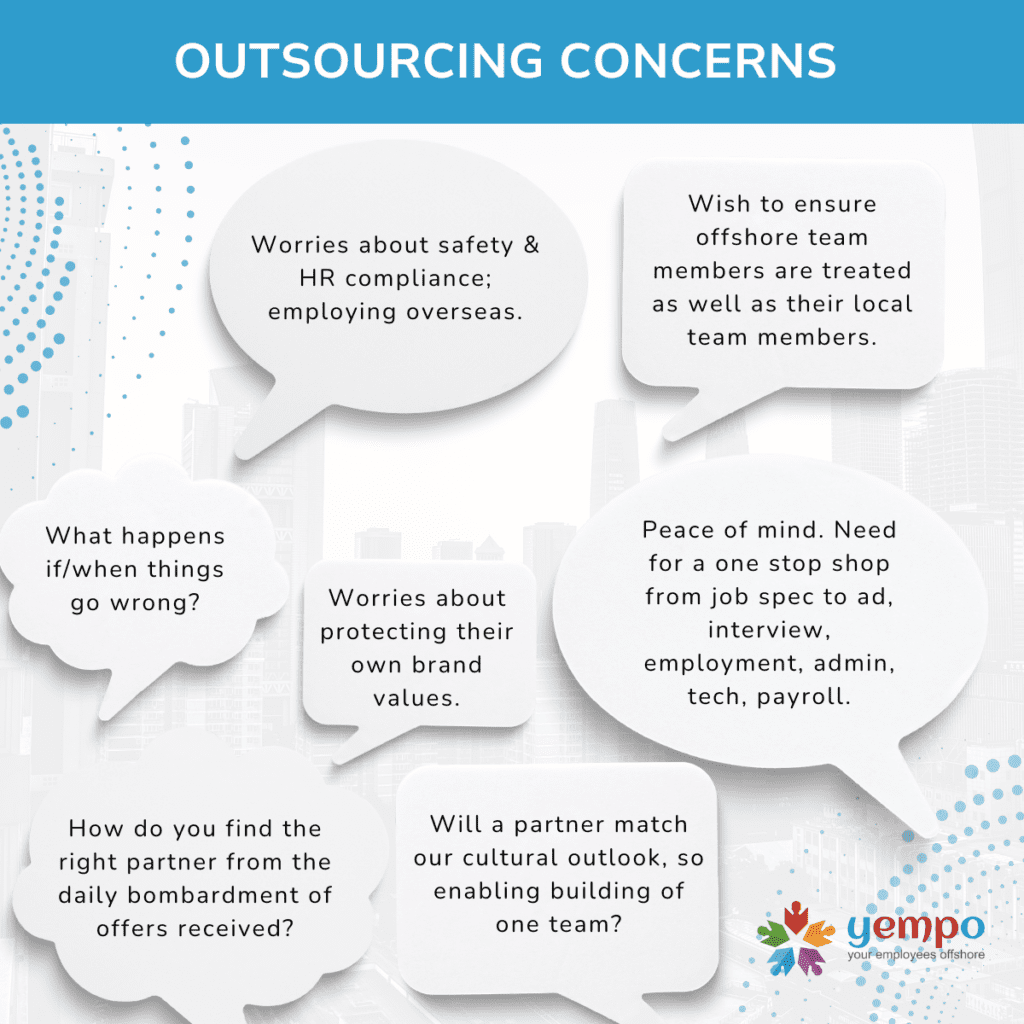
What concerns prevent organizations from
benefiting from outsourcing, leading to substantial competitive disadvantage compared to those that do?

We asked our research partner to investigate.
This is what our IT and Developer clients expressed as their primary concerns regarding adopting an offshore outsourced model.

All very reasonable concerns, we think you’ll agree.

Outsourcing concerns 1024x1024

In response, we’ve outlined steps that you can follow to discover your company’s ideal IT and Development outsourcing partner. Follow these steps to unlock the significant commercial and operational advantages that collaborating with the right offshore partner can bring to your organisations.

Step 1 – How to find IT and Development specialist outsourcers for your initial ‘long list’.

Pro tip: Many outsourcing companies initially operated as call centres rather than specialised providers of offshore IT talent. These organisations usually lack access to highly skilled and senior resources and struggle to retain top talent. Therefore, if a provider claims to offer a wide range of skill sets (such as admin, recruitment, engineering, healthcare, etc.), they may not meet your expectations.

The best place to start is by asking around your industry for recommendations and referrals. If this isn’t an option for you, then it’s time for Google. Aim for 5-7 providers on your long list. Need a shortcut? We’ll happily set you up for a chat with some of our IT clients.

Key considerations: Only include providers whose time zones and language skills suit your organisation’s requirements. For instance, if you operate an IT company and require additional client-facing personnel, you should ensure that they are in a time zone that aligns with your needs or in a location where 24×7 services are standard. A great example of a match is Australia and the Philippines. As one of our clients told our researcher.

“Excellent English and shared time zones make working with our Philippines-based team very easy”.

The Philippines also has ready access to staff willing to work rotating shifts, so your after-hours or US timezone requirements are a good match too.

Step 2 – Create a shortlist by finding IT and Development outsourcers that match your business culture.

Pro tip:

  • List what it is about your business that YOUR clients value.
  • Identify a shortlist of 3 potential partners that match what you and your clients value.

Your clients choose to work with you because you help them to hit their objectives. To find a suitable offshore partner for your business, aligning with what your clients prioritise is essential. Our advice? Dedicate some time to speak with your clients over the phone to ask these four simple questions:

  • What are the key features about your organisation that they value?
  • What are the key benefits that your organisation gives them?
  • What would they say makes your organisation distinctive vs. competitors?
  • Ask them to sell your organisation to you in 30 seconds.

You’ll learn what your clients REALLY value vs. what you think matters. You’ll understand your company culture like never before (and have relevant new client quotes for your marketing!). Then, ask your long list of potential outsourcing partners these same four questions.

Compare what your clients value vs. what potential partners have told you. Do they match? Yes? Fab. No? Cut from your long list.

“We have a lot of experience with offshoring, and Yempo is the first company we’ve found where delivery exceeds what we expected.” (Yempo client)

Key Considerations: Michelle, Yempo’s CEO, key things to look for in potential partners:

Step 3 – Dig into short-listed providers’ financial and operating models to avoid surprises.

Pro tip: ‘End-to-end’ outsourcing services and ‘all-inclusive outsourcing solutions’ mean different things to different people. Understand fees, how staff are selected & allocated to clients, technology provision, and management processes (particularly escalation routes to address any issues).

“We have a lot of experience with offshoring, and Yempo is the first company we’ve found where delivery exceeds what we expected.” (Yempo client)

Key Considerations:

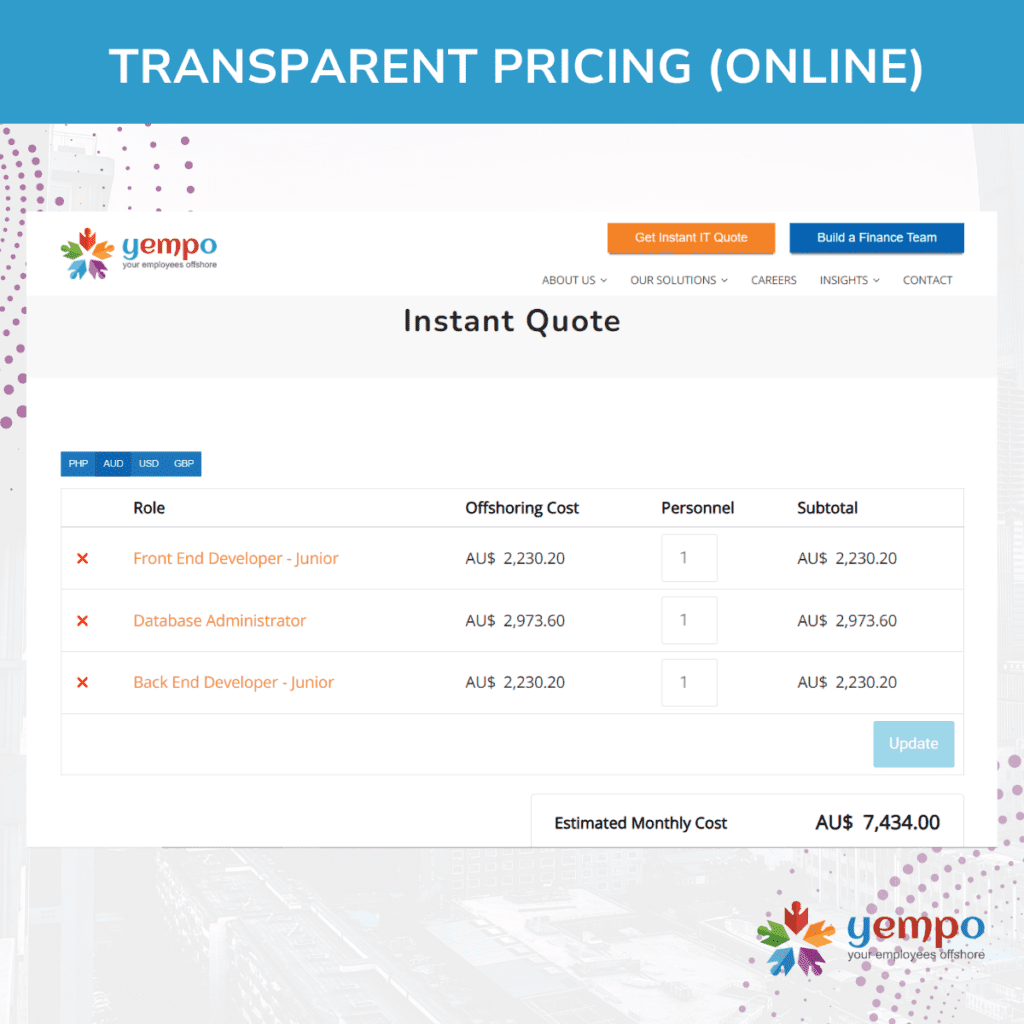
Pricing should be transparent. For instance, Yempo’s clients are informed about the staff’s salaries and Yempo’s administration fees. While other providers claim to have a transparent model, they often have undisclosed additional costs. Some operators impose recruitment fees, charges for meeting rooms, and fees for events and activities, among other hidden charges. It’s a long list. Avoid it.

Transparent pricing online 1024x1024

Ask about staff turnover. We believe you’ll agree that continuously hiring and integrating new team members is not conducive to progress, especially for smaller companies. Yempo’s employees usually remain with the company for over five years. Why? Because of fair compensation and outstanding working conditions. If the lowest price is your key metric, then
you won’t get employee loyalty.

“I met with other outsourcers and was not comfortable with the way they treat their staff. Michelle knows everyone by name and her staff warmly greet her. Yempo treats people well, so there is a ‘fit’ with our business’’ (Yempo client)

Screenshot 1024x452 1

Your team members or their staff? Some IT and Development outsourcing companies rotate staff, leading to disruption for clients. Meanwhile, some offer a “bench” model that may not always align with client needs and skill requirements, resulting in resource gaps. Yempo stands out by involving clients in the recruitment process (with guidance), enabling them to select staff who exclusively work for them. This approach enables clients to establish strong relationships and work practices across their local and offshore teams, distinguishing Yempo from other providers.

“Yempo isn’t just an outsourcer. Yempo facilitates adding YOUR team members to your teams. Not BPO, NOT ‘select from the bench.” (Yempo client).

Meet the person who will be your problem resolution/escalation point. It’s not uncommon for there to be a handoff between the people who sell to you and the people who manage your account. However, the true measure of a business partnership is only revealed when issues arise. It’s important to mitigate this risk. Our solution at Yempo is for Michelle, our CEO, to be available to all clients. This may sound impractical. Yet, it works. Why? Because problems are few and far between.

Michelle Fiegehen is an Aussie living and working in the Philippines.

“Michelle is incredibly accessible, and problems get solved fast. She sets a professional and values-driven tone that is always accessible and unique in my experience.” (Yempo client)

Check Data security measures meet standards. Avoiding brand damage and legal repercussions from a data breach is essential. It’s well worth having your IT and Data Security team/manager document your data security requirements. Do potential IT and Development outsourcing partners meet your security expectations? While this is unlikely to be an issue (as it’s a business fundamental for outsourcers) verifying their data security provision is still important.

HR Management Processes. Peace of mind that local HR legislation is understood and complied with is the number one concern of our clients.

Ask prospective outsourcing partners about
their HR processes. Do they have local HR
experts working for them? What stages of the
employee lifecycle are covered? Will they help
you write job descriptions? With candidate
interviews? How do contracts work?”

Yempo’s HR Director is Riza Tendero, a local HR
expert with decades of outsourcing expertise

Ms riza 980x980

“Yempo provides a seamless, supportive, end-to-end process. The business is unique as some of Yempo’s most senior leaders are Filipino, which is really helpful.” (Yempo client)

Does Technology (hardware, software, connectivity) meet your expectations? Working across countries requires great tech and internet connectivity. Do make sure that short-listed providers will commit to providing the same level of technology that your in-country employees enjoy. It’s well worth checking up-front the IT specs to ensure that your in-country and out of country teams can operate as equals.

Step 4 – Take references

Pro tip: Request to speak to at least three current IT and Development outsourcing clients. Ask them the same four questions that you used in step 2 (amended below). Compare answers to what your clients/you value. Is there a fit?

• What are the key features of the outsourcer that they value?
• What are the key benefits that the outsourcer gives them?
• What would they say makes the organisation distinctive vs. competitors?
• Ask them to sell the organisation to you in 30 seconds.

Key consideration: Communicate with companies of similar size to yours to gauge where they rank in each IT and Development outsourcers’ priorities. Will your business get the attention it deserves? Most of Yempo’s clients are small and medium-sized enterprises.

“Better skills than we can hire locally; more flexible, multi-skilled talent than we can hire from India. Interviewing, contracting, hitting dates, invoicing…it’s all been so easy that we thought there must be a catch!” (Yempo client).

Step 5 – Get cracking! Hire the IT and Development skills you need.

Pro tip: Start with a small team, prove the model, and expand.
What are you waiting for? If you’ve found the right IT and Development outsourcing partner for your organisation, they can now lead you through the hiring process and get you started on a new journey towards enhanced capabilities and lower costs.

“We wanted to find local staff but couldn’t. Yempo gives us the senior IT expertise that other outsourcers cannot provide.” (Yempo client).

Download the Free Guide

Thank you for visiting our blog! We hope you found our content informative and engaging. Stay connected with us for more insightful blogs, updates, and tips on outsourcing IT & outsourcing Finance in the Philippines, or shoot us an email at [email protected]. We are happy to answer your questions!

Learn more

Find & cost IT & Development talent you need. 

Read case studies

Explore your aims with Michelle, our CEO.

Download our Step-by-step Finance Outsourcing Guide

Follow us on LinkedIn

Filed Under: Offshore IT Teams

footer image

Book a call instead?

Skip the form and schedule a free, no obligation 30-minute consultation directly with one of our specialists.

Schedule

Get a local vs. Philippine cost comparison.

Share your talent gaps. We'll send you a cost comparison plus our end-to-end support process.

Yempo Solutions needs your contact details to allow us to get in touch about our services. To unsubscribe, or learn about our privacy practices, check out our Privacy Policy.

If you are a job applicant, please do not submit through this form. Visit yempo.ph for application procedures.

Icon

About Yempo Solutions

Yempo is the specialist provider of outsourced, Philippines-based accounting, finance, and Information Technology (IT) professionals to clients in  Australia, UK, US, Canada, New Zealand, Hong Kong, and Japan.

Contact Us

Email: [email protected]
Phone:

US: +1 (646) 693-2318

AU: +61 2 7200 7528

UK: +44 20 4599 6881

Company

  • Our Team
  • Our Story
  • Why Us

Solutions

  • Accounting & Finance
  • IT & Development
  • Business Support Services
  • Transfer Your Team

Compliance & Trust

  • Corporate Social Responsibility
  • Guides
  • Case Studies
  • FAQs

Legal

  • Privacy Policy
  • Cookies Policy

© 2026 Yempo Solutions. All rights reserved.

Get a quote within 24 hours

Share your open roles, receive a Philippine cost comparison.

Select the roles or solutions you are interested in.